Saturday, June 5, 2010

Honoree Shiela Betterton


It’s always exciting when a museum with a major quilt collection publishes a book showcasing the quilts in its collection. The American Museum in Britain published just such a book this winter—Classic Quilts from The American Museum in Britain (ISBN 13: 9781857595987)

[Click on highlighted words in green to follow links to more information.]

The Quilters Hall of Fame feels a special connection with The American Museum in Britain due to its relationship with the museum’s founding textile advisor, Shiela Betterton. Betterton created the museum's original quilt collection. As a result of her work with the collection—as well as her research and writing in the field of quilt history, Betterton was inducted into The (International) Quilters Hall of Fame in 1999.


Betterton, who was born near Newcastle upon Tyne in 1920, passed on December 26, 2008, at the age of 88. However, we are fortunate that this intrepid quilt historian was able to take part in this book before passing on. Indeed, she wrote the Preface to the book.

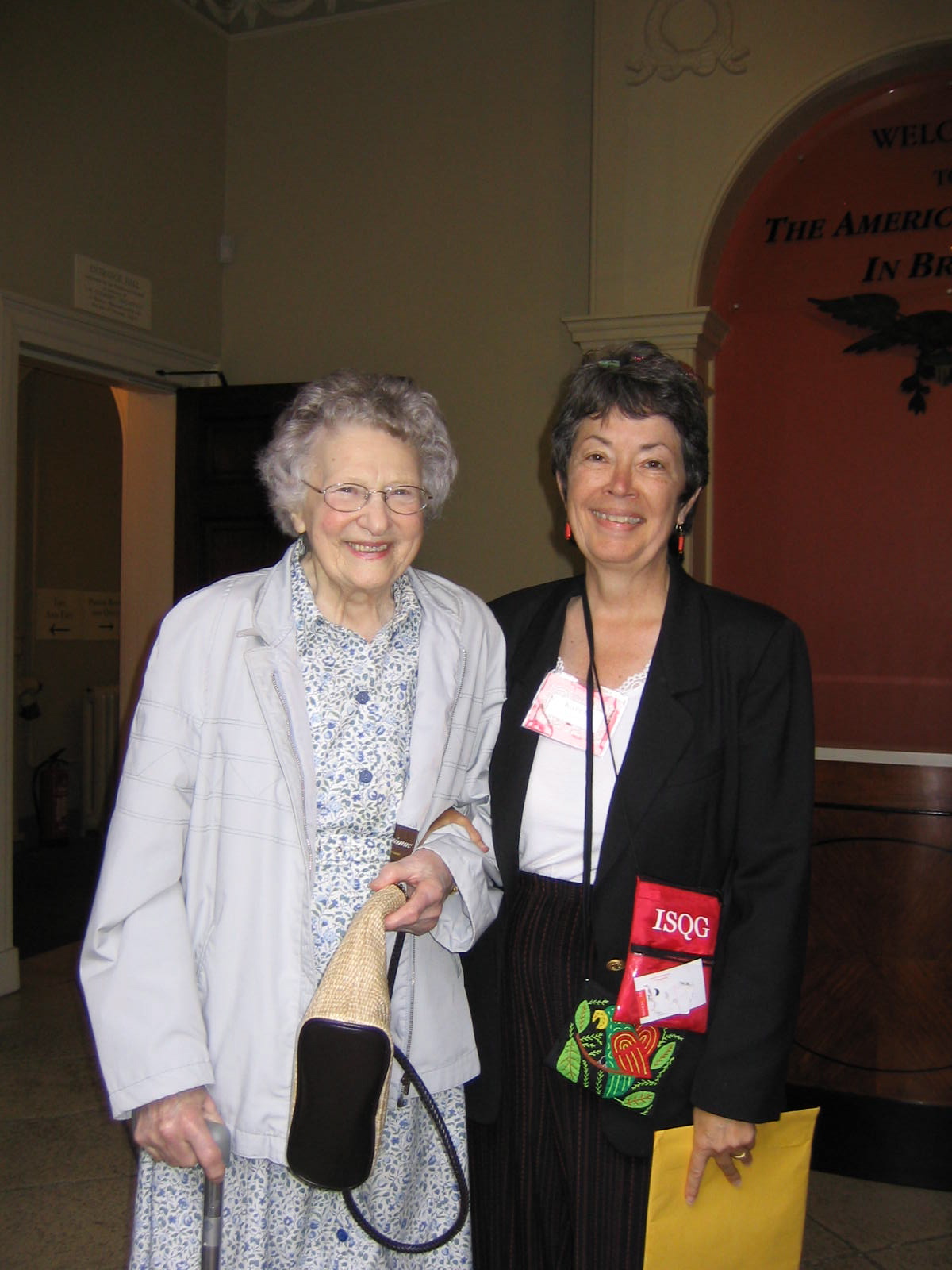
Left: Shiela Betterton is interviewed by Karen Alexander in September 2007 at The American Museum in Britain.


Classic Quilts from The American Museum in Britain has a little of everything when it comes to American quilts for the book’s authors, Kate Hebert and Laura Beresford, elected to showcase a wide range of examples from the museum’s collection. This particular collection of quilts is considered by many to be the finest collection of American quilts outside the USA.

Although the book is not an in-depth quilt history book, the photos of the quilts are gorgeous and the notes about each quilt give you basic information which offers a good starting point for further research, if you are so inclined.

There are two primitive basket designs to be found on two of the appliqué quilts in this collection that I found particularly delightful. See page 29 for one in the border of Miss Porter’s Quilt (1777 Eastern Seaboard) and page 35 for another in the border of an 1850 Rose of Sharon (New York State).

One of my favorite things about this book is its close-ups of the fabrics in several of the quilts, in particular the Mosaic quilts on pages 52-55, both which happen to be from Virginia.

The close-up photos of fabrics is a real plus for anyone wishing to learn how to date quilts by studying the fabrics they contain. However, I am ever wanting more, especially of the quilt shown on page 96 (Log Cabin Quilt – Barn Raising Variation from Vermont) whose back is made up of sixty (7 inch square) blocks. The blocks themselves consist of half-square triangles. The variety of fabric scraps used in this quilt's back would delight any lover of early cotton fabrics.

Interested in further fabric studies? Click here to see the excavation of a quilt within a quilt. Click here to see a Dye History Timeline.

This books is a must buy for its photos alone in this writer’s opinion.

Karen B. Alexander
Quilt Historian
Past President
The Quilters Hall of Fame

Star of Bethlehem Quilt (c. 1835) on back cover of Classic Quilts from The American Museum in Britain


PS: You can read more of my quilt research by clicking here.


Friday, January 8, 2010


Jean Wells Kennan


Cottage Quilt Industries

Become Big Business in Late 20th Century

Introducing Jean Wells Keenan of Sisters, Oregon

by Karen B. Alexander


poster by Dan Rickards

Quilting in the 20th century has touched many lives in profoundly different ways. Some quilters have even gone on to create a business out of their passion that has enabled them to support themselves and even their children. A few have even put those children through college! But the one thing quilters all seem to have in common is our love of color and the feel of the fabric beneath our fingers.

In a previous article I shared with you the success Ruby McKim experienced with her quilt pattern business in the first half of the 20th century and touched briefly on Marie Webster’s quilt business success as well. These successes are only some of the contributions both women made to the quilt world that earned them induction into The Quilters Hall of Fame.

Jean Wells Keenan of Sisters, Oregon fits right in with these two earlier multi-talented female entrepreneurs. Some call such businesses “cottage industries”. However, Keenan took her talents as a teacher, designer, author and quilt shop owner to another level all together.

Let's Look Back for A Moment


Interest in the various needlearts tend to wax and wane with every generation. The fluctuating interest in quilting in the 20th century is no exception. Although much had previously been written about weaving and embroidery and even lace-making, it wasn’t until the publication of Marie Webster’s book “Quilts: Their Story and How to Make Them” that anyone had attempted to write a book solely dedicated to the history of the quilt.

Webster’s designs, which began to appear in 1911 in The Ladies’ Home Journal, and her 1915 book set-off a new national interest in quilts. Marie’s story* is a fascinating one, especially in light of all the quilt-related businesswomen that would come after her.

As the U.S.A. approached its bicentennial in 1976, the emergence of women’s history as a separate field worthy of serious academic study is now a well-documented fact. The proliferation of serious quilt history followed shortly thereafter. The founding of the American Quilt Study Group (AQSG) in 1980 by Sally Garoutte of Mill Valley, CA specifically helped set high academic standards for this newly emerging field.

The concept of needlework “cottage industries” touches upon this article's subject. However, Jean Wells Keenan—a renowned quilter and teacher—would take the concept of "cottage quilt industry" one giant step further in the late 20th century.

Cottage needlework industries were certainly not unheard of in the first quarter of the 20th century, but not all of them impacted the direction of quilt design to the degree that both Marie Webster and Ruby McKim did. An excellent paper by quilt historian Cuesta Benberry (1922-2007), “Quilt Cottage Industries: A Chronicle,” established groundbreaking research on this subject. You can find Benberry’s article in the 1994 hardback book, Quiltmaking in America: Beyond the Myths, published by AQSG. Amazon.com carries used copies.

Both Webster and McKim were forerunners of an explosion of similar quilt-related businesses that emerged during the late 20th century quilt revival. One only has to track the ads in the popular needlework and quilt magazines of the time to see these phenomena emerge. The Internet and other new technology only added to women’s ability as well as opportunity to create and work from home at something they loved.

2010 TQHF Inductee —Jean Wells Keenan

The life and career of the newly announced 2010 Quilters Hall of Fame Inductee —Jean Wells Keenan of Sisters, Oregon—is an excellent example of the influence of one of the foremost quilt entrepreneurs of the late 20th century. Keenan came to her ultimate profession within quilting through a serendipitous occurrence in her career as a Home Economics teacher in the Oregon public school system in the 1960s. However, her interest in sewing began far earlier in childhood.

The Roots of a Future Career

Although no one in the family quilted during the years Keenan was growing up, Keenan was fortunate to have a grandmother who greatly enjoyed sewing and crochet and noticed the budding interest of her two granddaughters in sewing and encouraged them.

Ah, what a difference a grandmother can make in a child’s life. The seeds were thus planted, watered and tilled. What an amazing variety of creativity would one day emerge from such a humble beginning.

Many shifts were occurring in the fiber arts world in the second half of the 20th century that further set the stage for someone like Keenan. Addressing these changes in a 1993 Uncoverings article, Honoree Bets Ramsey wrote: “… between 1950 and 1970 certain artists began to adopt and incorporate various quilting techniques in their work, coinciding with a new awareness of the value of women’s work and an acceptance of fiber as an art medium.”

About this same time educators in the late 1960s began asking, “Why are we pushing only gender-specific Home-Ec and Shop classes? Girls need to learn to use tools and boys need to learn to survive in a kitchen and thread a needle.” It was this particular cultural shift that was the catalyst for setting Keenan’s interest in quiltmaking in motion.

Shifts in Educational Goals

In 1969, in the process of fulfilling her new curriculum requirement to find a project to assign to the boys in her class, Keenan came across some English patchwork in a book. What appealed to her were the geometric shapes. Geometry, numbers, math! What an excellent vehicle for teaching various lessons, not the least of which was accurate cutting and sewing! This was not frou-frou stuff as any quilter knows, as well as any engineer. Accurate measuring, dexterity at intricate assemblage and patience is something that any student can benefit from.

Keenan had the boys make floor cushions but was soon taken with the whole process of putting colorful fabrics together in a variety of new shapes. Having loved sewing and fabric since childhood, this new venue was right down her alley. It didn’t matter that she had never seen quilts made. Patchwork was still sewing and it was done with a colorful variety of fabric and patterns. Piecing is piecing, right?

Quilting on the Rise Across the Country


The 1960s and 70s also saw the rise of other events that stirred up new interest in the fiber arts: the first quilting cooperatives; the formation of numerous new quilt guilds across the country following the American Bicentennial and the introduction of quilt conferences, beginning with the creation of the Mill Valley Quilt Authority in California, founded in 1970 by Joyce Gross and Sally Garoutte.

The creation of other major quilt-related organizations followed: the National Quilting Association (1970) in Greenbelt, MD; the launch of Bets Ramsey’s annual Southern Quilt Symposium in conjunction with Hunter Museum (1974) in Chattanooga, TN; and the creation of the Continental Quilting Congress by Hazel Carter in 1978 and her subsequent creation of The Quilters Hall of Fame the following year.

In 1975 Karey Bresenhan, stepped onto this stage just about the same time, creating her first “Quilt Fair” in Houston, Texas, and founding Quilt Market four years later in 1979. “Quilt Fair” would eventually morph into the International Quilt Festival, the largest quilt event in North America. Quilt Market, designed exclusively for quilt shop owners, is arguably the event that gave credence to and created an industry from a cottage craft. As Honoree Donna Wilder wrote me recently, Quilt Market, from the earliest years of the late 20th century quilt revival, "brought together companies and quilt shops, spreading the awareness of quilting and expediting the styling and availability of quilting fabrics and notions, that made it possible for quilt shops to grow and prosper.”

Jean Wells Keenan stepped onto this stage in the mid-70s, her talents and love of teaching now poised to take off in a whole new direction, and take off she did.

The Second Step: Keenan's Dream Emerges

A year after moving to Sisters, Oregon, Jean Wells Keenan decided to use money from her teacher’s retirement account to rent space where she could teach quilting as well as sell quilting supplies. That same year she also launched the first Sisters Outdoor Quilt Show. This was 1975, an auspicious year when you consider it in the context of the events listed above.


Just a year or so earlier Keenan had discovered old family quilts her mother had packed away in family cedar chests. What an exciting catalytic discovery that must have been for her as well. Quilts were not uncommon in her family after all!

When Keenan opened The Stitchin’ Post in 1975, could she possibly imagine what lay ahead — an outdoor quilt show that would eventually exhibit some 1200 quilts each year from around the world and would utilize some 3,000 volunteer hours from a cooperative community to pull off? An annual week-long “quilt school” showcasing some 30+ teachers? Twenty-seven books, including the 11 she has co-written with her daughter Valori Wells Kennedy? Perhaps not. But in fact because of those first steps she dared to take, the dream became a reality, enhancing countless lives.

A Life-Changing Event for A Whole Community

The impact of the growth of the Sisters Outdoor Quilt Show on the community of Sisters, Oregon is not difficult to imagine. With the surge in interest in quilting following the U.S. Bicentennial, the Quilt Show grew so large that a non-profit corporation was eventually established to manage the show and related events for the benefit of the Sisters community and school groups, and to educate the public about the art of quilting. This is one of those rare occurrences in quilt history where quilting changed a whole community. This in itself sets Jean Keenan Wells apart from the average quilt shop owner.

This amazing woman’s impact continued to expand year after year. In 1979 she wrote her first book. In 1980, the year after Hazel Carter founded The Quilters Hall of Fame as an adjunct of the Continental Quilters Congress, Keenan added the Quilter’s Affair, a week-long schedule of workshops that coincides with the Quilt Show. Today it attracts close to 1600 participants from all over the world.

Whole families drive to Sisters each year and camp out for the week so that the quilter in the family can attend classes. The estimated numbers for the over-all crowd that is attracted to Sisters each year — some just to see the quilts and to shop — is 15,000-20,000. Keenan further assists the community by hiring local high school students to tote sewing machines and materials to and from classes each day; play jazz during Picnic in the Park; set-up and serve and clean up the Picnic in the Park for 800+ guests; conduct the Around the Block Fiber Art Stroll; plus pick up trash throughout the weekend.

"Paradise Garden" by Jean Wells Keenan

Always one to be deeply involved in community activities, Jean Wells Keenan served on the Sisters School Board from 1975-1978, (chairing the committee 1977-1978), and early on became an active member in the Sisters Area Chamber of Commerce, a relationship she maintains today. In 1984 she became a participant in the Central Oregon Community College Small Business Development Program, and later became an advisor to the Oregon State Board of the Small Business Program, as well as a Board member for the Central Oregon Economic Development Council 1989-1991.


As one letter nominating Keenan to the hall of fame read, “To name all who she has encouraged to develop their full potential would simply be impossible.”


Oldest Quilt Shop in the USA?


It is quite possible that The Stitchin’ Post is the oldest quilt shop in the U.S. Certainly it’s the oldest quilt shop still in the hands of its original owner. In acknowledgement of her business acume, Keenan was named recipient of the Michael Kile Award for Lifetime Achievement in 1998, the highest award that the quilting business industry gives. She was also the first quilt shop owner to be inducted into the Independent Retailer Hall of Fame in 1997. In 2008 she was one of eight Oregon State University alumni honored in its year-long Centennial Celebration salute.

Keenan is indeed a major player in today’s evolving “quilt world,” with its far-reaching impact on commerce, manufacturing, and related technology. She has also made many contributions to the beauty and aesthetics of this well loved art form and has traveled the world to teach both quilting and the business of successful quilt shop management.

Active for almost three decades as a noted quiltmaker, author, designer, teacher and entrepreneur, Keenan has managed to stay on top of a fast paced and changing retail business in its many complex aspects. At the same time she was consciously looking to the future once again. Kennan diligently prepared the next generation in the person of her daughter Valori Wells Kennedy to carry-on the quilt legacy and responsibilities in the Sisters's community, making Valori her partner in 2005.

Keenan the Designer

Keenan is also a passionate gardener and, like Marie Webster, her gardens greatly inspire and influence her quilt designs.
In writing all of the above, we haven’t even touched upon Keenan’s award winning quilts, some of which you can see here, or her gifts as a designer.

There is so much more to explore about this talented, generous businesswoman and quilter.

Keenan is well deserving indeed of the honor of becoming The Quilters Hall of Fame’s 40th inductee. Mark your calendars for July 15-17, 2010 and come celebrate with her.

Although the Celebration 2010 Registration form for Keenan’s induction won’t be available until April, there are other interesting news items to see on the TQHF website and on the TQHF blog between now and Celebration 2010.

Meanwhile, keep those needles flying and spread the word about how quilts enrich your life as well as the life of our communities!

Karen B. Alexander
Quilt Historian


PS: All articles and material (including photos) on this blog are copyrighted. Please click here if you wish permission to quote significant portions.

Please have the courtesy to cite this blog as a source if you quote short portions or use any information you read here in any published format.
Sources:

1) The Alliance for American Quilts, Q.S.O.S. Tape No. 71; interview of Jean Wells Keenan by Leah Call, November 3, 2003

2) Bend Bulletin, Bend, Oregon, May 5, 2009; Jean Wells Keenan interview by Kimberly Bowker

3) Bets Ramsey, “Art and Quilts: 1950-1970”, Uncoverings 1993, Laurel Horton, ed. (San Francisco: American Quilt Study Group, 1993) 9-40

4) C&T Publishing: The Stitchin’ Post named an Inspirational Shop

5) Jean Wells Keenan's nomination was organized and spearheaded by Anne Foster of Portland, Oregon. Selected letters from this nomination file were referenced for this article: Rose Horton, Kathy Pazera, Kathie Olson, Donna Wilder, Karen Bresenhan, and Alex Anderson. All letters of nomination are on file at The Quilters Hall of Fame.

6) See Oregon State University Synergies, Nov 1, 2008

*Marie Webster’s granddaughter, Rosalind Webster Perry, republished this seminal work in 1990 but added a comprehensive must-read chapter about Marie’s own life and business. “Quilts: Their Story and How to Make Them” is available through the TQHF Museum Shop.


PS: You can read more of my quilt research by clicking here.

Thursday, December 3, 2009

The Legacy of Cuesta Benberry


The Legacy of Quilt Scholar Cuesta Benberry 


Photo courtesy of Michigan State University Museum


Michigan State University Museum Exhibit Shows Newly Acquired Quilt Collection
(Click here to see the story of the above quilt.)


In a new exhibition opening Dec. 6, the Michigan State University Museum will premiere the textile collections of the late Cuesta Benberry, one of the twentieth-century's pioneers of research on American quiltmaking and the forerunner of research on African American quiltmaking.

"Unpacking Collections: The Legacy of Cuesta Benberry, an African American Quilt Scholar" explores the production and meaning of collections and, for the first time, shows this new collection acquired by the MSU Museum in 2009. The exhibit runs Dec. 6, 2009 - Sept. 5, 2010 after which it will begin its national tour.

"Every collection reflects a point of view, a passion, a mindful purpose of the collector who made it," explains Marsha MacDowell, MSU Museum curator of folk arts and MSU professor of art and art history. "In literally unpacking a scholar's collection, a museum or an archive has a responsibility to care for, research, interpret, and make accessible the contents of the collection. It is when a collection—its parts and its whole—is figuratively unpacked, that we can learn more about the scholar and the subjects they researched."

Photo courtesy of Michigan State University Museum


Click here to read the story of the Black Families Series #1 by Carolyn Mazloomi.)


The Cuesta Benberry African and African American Quilt and Quilt History Collections contains 52 quilts (including family quilts and the only one Benberry actually made), notebooks, quilt kits and patterns, and scores of notes and clippings related to quiltmakers, quilts, and quilt exhibitions. A founder of the American Quilt Study Group in 1980, Benberry was also the author of several books about quilt history, including "Always There: The African American Presence in American Quilts" and "A Piece of My Soul: Quilts by Black Arkansans." See a "Quilt Treasure" web portrait of Cuesta Benberry here.


Photo courtesy of Michigan State University Museum


(Click here to see the story of the Shoe Quilt.)

Benberry had a long association with the MSU Museum, the home of the Great Lakes Quilt Center, and when she passed away in 2007, her family gave the Michigan State University Museum her collection of African and African American quilts and her quilt history. Then in 2009, the American Folk Art Museum in New York City transferred its Benberry collections to the MSU Museum so that the bulk of her work could be in one place where it could be more effectively accessed for research and educational uses.


Photo courtesy of Karen Alexander

(The same quilt as it hung at Cuesta's memorial service.)


Over the past year, MSU Museum staff, students, and volunteers have been "unpacking" — sorting through, cataloging, and re-housing Benberry's collection.

"In the process, these workers have been engaging in discussions of their observations about both the collection and the collector and the issues and insights that help make collections available for research, teaching and exhibitions," adds Mary Worrall, co-curator of the exhibition and Assistant Curator, MSU Museum.

The work is not complete with this exhibition, MacDowell says. With an Institute for Museum and Library Services National Leadership grant, the MSU Museum is now working to make selections of Benberry's extensive collections digitally accessible to a worldwide community of researchers and educators. Already the quilts from her collection have been added to the Quilt Index and selections from the rest of her collections will also eventually be available on the Internet.

A series of related educational programming, including lectures, workshops, demonstrations, and a symposium are now in the process of being planned and information on these will be announced in January and will be posted at .

The MSU Museum's Great Lakes Quilt Center has evolved from the sustained and significant quilt-related activities and resources at the Michigan State University Museum and the museum's long-standing interest in and commitment to preserving and presenting traditional arts history. Learn more at: www.museum.msu.edu/glqc/index.html

This exhibition is made possible by a Creating Inclusive Excellence Grant from the Office for Inclusion and Intercultural Initiatives at Michigan State University with additional support from an anonymous gift.

The MSU Museum is Michigan's natural science and culture museum and the state's first Smithsonian Institution affiliate. The MSU Museum—accredited by the American Association of Museums—collects, preserves, studies and interprets cultural artifacts and natural science specimens, with collections numbering more than 1 million in four buildings on the MSU campus. One of the oldest museums in the Midwest, the MSU Museum is committed to education, exhibitions, research and the building and stewardship of collections that focus on Michigan and its relationship to the Great Lakes and the world beyond.

The MSU Museum features three floors of special collections and changing exhibits and is open seven days a week free of charge (donations are encouraged). Located on West Circle Drive next to Beaumont Tower on the MSU campus, the MSU Museum is accessible to persons with disabilities. Hours are Monday - Friday, 9 a.m. - 5 p.m.; Saturday, 10 a.m. -5 p.m.; and Sunday, 1-5 p.m. Visitor parking is available in front of the building and at metered spaces at the Grand River Ramp, one block away at the corner of Grand River Avenue and Charles Street. For more information, call (517) 355-2370 or see http://museum.msu.edu .

Additional links on Cuesta Benberry:

1) Quilt Treausres at Alliance for American Quilts
2) Watch video interview of Cuesta Benberry
3) "Remembering Cuesta" by Karen B. Alexander
4) New York Times article.
5) Washington Post article.


PS: You can read more of my quilt research by clicking here.
Friday, November 20, 2009

The Quilt Index and Merikay Walvogel


Our 2009 Honoree, Merikay Waldvogel, has been deeply involved in The Alliance for American Quilts for a number of years and has been especially active in helping with two of their projects: The Quilt Index and Boxes Under the Bed.

The Quilt Index is a collaboration of The Alliance for American Quilts, Michigan State University Museum, and MATRIX: The Center for Humane, Arts, Letters and Social Sciences Online. If you haven't yet browsed The Quilt Index, you are in for a treat.

(photo by Sue Jones)


Coinciding with the launch of the new and improved Quilt Index site is the launch of their Signature Quilt Project. You can now search to see if there is a particular name on a quilt or even a place name. However, most Signature quilts uploaded to the Index before the creation of the Signature Quilt Pilot Project do not yet have names transcribed. This will all take time.


Three blocks from a New York Signature Quilt


Transcription can be challenging if signatures are numerous or difficult to read, but it is very rewarding to make the effort. In the process be reassured, you are adding important information to women's history, quilt history and community history.

To read the behind-the-scenes story of one research project in progress on a New york Signature quilt, click here.

(Click on photos to enlarge.)

In addition, I have just finished transcribing 250+ names on a 1941-1942 Navy Signature Quilt now in the Quilt Index Signature Quilt Pilot Project.


I know Merikay Waldvogel—as well as our other Honorees—would encourage all of us to document all of our quilts but especially our Signature Quilts! You can download a form by clicking here and begin documenting your own quilts. If a museum or State/Regional Documentation Project wishes to enter a collection into The Quilt index, visit this link for guidelines.

In addition to quilts, The Index is also beginning to digitalize quilt ephemera beginning with The Quilt Journal - An International Review. You can now download individual issues of this journal as a pdf file by clicking here. Waldvogel is now assisting The Quilt Index with the digitalization of her own extensive quilt history ephemera collection.

Another exciting project to look forward to when completed — with NEH support, the Quilt Index project team andhe American Quilt Study Group (AQSG) have worked together to digitize abstracts for AQSG's journal, Uncoverings, and to develop a plan and budget for future inclusion of the journal in the Quilt Index.

The founder of AQSG, Sally Garoutte, is also an Honoree of The Quilters Hall of Fame as are several very early members of AQSG: Joyce Gross, Cuesta Benberry, Barbara Brackman and Bets Ramsey. You can read a short biography of each here.

Click here for an article by Merikay Waldvogel
about the AAQ Crazy Quilts contest.

Click here for Part 1 of an interview of Merikay by "The Collector's Weekly".

Click here for Part 2 about collecting American quilts by Merikay Waldvogel in "The Collector's Weekly".

Until the next TQHF update,

Karen Alexander
Click here to reach me by email.


PS: You can read more of my quilt research by clicking here.

Monday, August 17, 2009

Merikay Waldvogel Induction Celebration


Celebrating the Induction of Merikay Walvogel
and 30 Anniversary
of The Quilters Hall of Fame!


Welcome!


The event that officially kicks-off the Induction of a new Honoree into The Quilters Hall of Fame is the narrated walk-thru the Honoree conducts of her/his exhibit. Here we give you an overview of the exhibit as Merikay Waldvogel begins sharing her stories, followed by selected photos with accompanying exhibit notes prepared by the Honoree that appeared in the official commemorative program book.

Each new Inductee presents an exhibit of her/his choosing at the time she is inducted. Merikay Waldvogel chose quilts that reflected her 30-year journey as a quilt collector and quilt historian. All exhibit notes in this post in italics come from the TQHF 2009 exhibit notes written by the Honoree.

Photos in this report are courtesy of Merikay Waldvogel, Debbie Quinn, Barbara Brackman, Sue Jones and Rosalind Webster Perry. Please do not use without written permission from TQHF. )

(You can click on any photo to make it larger.)


A Quilt Career Begins

In 1980, I named my quilt business "Quilts Alive." I planned it as a side-line interest to my then full-time job as an English-As-A-Second-Language teacher. I would write about, lecture on, and research quilts. My business cards carried a line drawing of my first quilt—an oddly shaped North Carolina Lily quilt I bought in 1974. I had had an on-going conversation with that quilt. First it was, "Oh my gosh, that's a fabulous quilt!" Then when I owned it, I wanted to know more. I headed to the library. I networked with newfound quilt experts. The goal was to bring that quilt to life.

After all these years and long after I took on a full-time quilt career, the phrase "Quilts Alive" still encapsulate the joy I feel when studying quilts and quiltmakers. In a sense, I am bringing these historic textiles to life and giving voice to the women (and yes, men) who made them. This exhibit contains some of my favorite quilts: quilts collected for their fabrics or patterns; quilts made in Tennessee, my adopted home state; quilts that sparked a specific research project; quilts made by family and friends; and quilts I have made.


Here Waldvogel shares the story behind Milky Way Log Cabin made by Sara Frances Abernathy Smith circa 1900 of Pulaski, TN.

The quilt behind Merikay is a Basket Quilt - Maker Unknown, Knox County, TN, 1910s-1920s. To learn more about the Milky Way Log Cabin quilt, go to The Quilt Index here. When that page opens, click on "Search" at the top of the page and type in the name of the quilt or the maker's name.


(Coxcombe & Currants - left)


The Coxcombe & Currants quilt at the bottom is ca 1850s-1860s from an estate sale in Cleveland, TN. This is a pattern that must have originated in East Tennessee since I have found a dozen other quilts using this same large four-block wreath design with a historical link to the Cleveland area. This one is probably older than the other. It is more heavily quilted and the solid green fabric is typically found in 1850s quilts.

The Coxcombe & Currants at the top is similar in overall layout, but is less elaborately quilted and the green has faded to a beige color which often happens with green fabrics of 1880s quilts. The antique dealer was having the machine-stitched binding replaced with a hand-stitched one. I told her I would take it "as-is" since machine-stitching is an important clue to the date of the quilt.


Bird's Eye View of the Chicago World's Fair - by Richard H. Rowley, Chicago in 1933 (photo on right)


The Sears National Quilt Contest, held in conjunction with the 1933 Chicago World’s Fair, attracted over 24,000 entries probably because of the $1000 grand prize. There was a bonus prize of $200 if the grand-prize quilt was an original design commemorating the Fair’s theme—A Century of Progress. Unfortunately, the judges did not consider the original designs worthy of top regional prizes. Few reached the final round of judging.

In 1934, to calm the criticism, some of the originally designed quilts were displayed in the Sears Pavilion when the Chicago World’s Fair was re-opened for a second summer. This quilt with its entry tag clearly visible was photographed at that time by Sears. Barbara Brackman and I both tried to find “Mrs. Louise Rowley” and her quilt, to no avail for our book. We included only the photograph.

In 2001, I purchased the quilt at an antique auction in N. Georgia. The quilt came with a hand-written note saying, “This quilt was made by Richard H. Rowley, the son of Louise Rowley.” And there began another interesting research venture to find out more about Richard and why he made this quilt.

(You can see this quilt in the book "Patchwork Souvenirs of the 1933 Chicago World’s Fair" page 13.)


To the right, Jerry Ledbetter, Merikay's husband shares his quilt's story.
For Christmas one year, my husband asked people to make House Quilt blocks for his Christmas present. He hoped he would get enough to make a full-size bed quilt. With red solid and red print fabrics he gave them, some people did their own houses in appliqué. Others signed traditional quilt blocks that his mother made for them. As the blocks came in, he drafted a quilt layout with triple sashes. His mother, Virginia Ledbetter quilted it by hand on an old-fashioned quilt frame suspended from the ceiling.

This quilt was also exhibited at the National Quilting Association 1990 Show in Knoxville, Tennessee.


Sampler Quilt Top-only by Iora Almina Philo Pool, Morgan County, TN, 1870s-1880s. (Collection of Linda Claussen)


Bets Ramsey and I documented this quilt top in the mid 1980s and included it in our book Quilts of Tennessee. Nearly 25 years later, the quilt top appeared in an antique store in Chattanooga. Hearing of the news, Linda Claussen quickly made arrangements to acquire the quilt top. Jean Lester has been restoring it so that it can be displayed. This is its first public viewing. Bets Ramsey, writing about this quilt in 1986, surmised that the maker wanted “to make as many different blocks as she could. Having no regular set, the units flow into each other in happy medley.”

For more wonderful photos of this top, see: Ramsey and Waldvogel Quilts of Tennessee: Images of Domestic Life Prior to 1930 (Nashville: Rutledge Hill Press, 1986), 12 and 108 and Eva Earle Kent “The Tennessee Heritage Sampler: Reflecting Quiltmaking Tradition” in Quilters Newsletter Magazine #211 (April 1989).


Special friend Susan Salser had a bouquet designed to resemble the centerpiece applique bouquet of her grandmother Mary Gasperik's Indiana Wreath quilts. Salser and Waldvogel collaborated on the Mary Gasperik Quilt Index, the first private collection added to the Quilt Index. The bouquet designed by Carol and Randy Power of Marion, Indiana was a spectacular complement to both the induction banquet and the exhibit gallery.

To see Mary Gasperik's "Indiana Wreath" quilts, CLICK QUILT INDEX HERE. Then enter "Indiana Wreath" in the Search box.


Here it is — the North Carolina Lily quilt that got Waldvogel started!


Without any knowledge of quilts—new or old, I purchased this quilt one Saturday morning in the mid 1970s. I was looking for some artwork for my studio apartment in Chicago. The asymmetry of the patterning made me wonder about the maker and what was going on in her life. Unfortunately, I never found out.

I learned my first important lesson to always ask the seller for information about the quilt, the place it was made or the quiltmaker. Even without that key information (and maybe because of not having it), this anonymous quilt opened up an avenue of exploration that greatly enriched my life.


(Exhibited first: “A Patchwork Garden” at The Hunter Museum of Art, Chattanooga, TN April-May 1981. You can see a large photo of this quilt on page 62 of Quilt with the Best edited by Carol Cook Hagood (Oxmoor House, 1992). See the page with this photo in Quilt with the Best below in the display Waldvogel put together.)


A Small Side Exhibit:
Wandering Down Memory Lane


Books, photos, research notes, letters and other memorabilia from Merikay’s archives were nicely arranged in nearby display cases by Debi Shepler of Marion. This was an absorbing display of a busy researcher's challenges, accomplishments and humorous moments.

Waldvogel's collaboration with 2001 Honoree Barbara Brackman on Patchwork Souvenirs of the 1933 World’s Fair was a major contribution to quilt research.
Waldvogel also co-authored two books with Honoree Bets Ramsey and her own book Soft Covers for Hard Times added greatly to the knowledge of the revival in the interest of quilt making in the 1920s and 1930s.

The blue and off-white Square in a Square quilt in this cabinet was pieced by Waldvogel and machine-quilted by Shirley Greenhoe.

Waldvogel exhibit notes read: I made this quilt at a workshop led by Barbara Brackman at the Point Bonita Getaway in 2006. Started by [Honoree] Joyce Gross, the annual week-long retreat in California held in late January is now headed by Kathy Ronsheimer. Point Bonita is the time when I actually try to make quilts, but given its spectacular location on San Francisco Bay, I am more often out walking, hiking, and gazing at the sunsets.


Here you see Southern Quilts: Surviving Relics of The Civil War, one of her collaborative books written with Honoree Bets Ramsey.


Other Honoree Events


In addition to the special exhibit our Inductees present each year, they also presents a lecture and/or workshop depending upon their own specialty in the quilt world. This year Waldvogel organized a panel on quilt pattern collecting and presented a lecture.


Left to right: 2001 Honoree Barbara Brackman, Merikay Waldvogel and Connie Chunn of St. Louis, Missouri.

The two hour panel covered a lot of information. Barbara Brackman presented a humorous overview of collecting, sorting, and retrieving. She talked about how she originally compiled her pieced pattern encyclopedia and announced the forthcoming reprint of her applique encyclopedia.

Next Merikay Waldvogel showed how Round Robin pattern collectors compiled, listed, shared, and retrieved their patterns and in addition talked about the early newsletters and their impact on quilt pattern collecting.

Connie Chunn prepared a powerpoint presentation that detailed her findings about the people behind Ladies Art Co. of St. Louis, Missouri and showed examples of their numerous catalogs and patterns, sharing how she used the internet to purchase items for research. She also used the traditional methods of research including: genealogy, library reference materials, and other archives.

Waldvogel wrapped up the afternoon with a presentation of her kit quilt database and shared a handout on the data she has compiled to date. Then an audience member thrilled everyone by sharing a Tree of Life Progress 1369 kit quilt in the original brown envelope. By all reports, it was a rare find and very exciting to see in person!


In the Honoree lecture Merikay shared some of the fascinating stories behind her research on the 1933 Chicago World's Fair Contest.

Improvisation is the name of the game when unexpected things happen in life. When a projector bulb blows during a lecture, you punt so Waldvogel called in the troops. Fortunately she had brought large photo blow-ups of a number of pictures she had planned to project as slides and, of course, had some great quilts to share as well. Family members and friends had no idea that they would become a part of the show, but perform they did! Thank you one and all for your part in helping the show to go on!

The Autumn Leaves quilt behind Waldvogel in the above photo made by Edith Tessman Snyder won third place in the Philadelphia region of the Sears Contest and was one of only 30 final round quilts shown at the Chicago World's Fair. Merikay invited the quilt maker's daughter Pat Sittler of nearby Silver Lake, Indiana to bring the quilt and share her mother's story.

(Click on the following photos to make larger.)


The Official Induction Ceremony


At the official Induction Luncheon on Friday July 17, TQHF President Joyce Hostetler presented Merikay Waldvogel with her official Honoree medal, a tradition begun by TQHF founder Hazel Carter in 2004 when the Marie Webster House opened as the official headquarters of The Quilters Hall of Fame.


Next Waldvogel receives her Wild Woman doll pin, a tradition begun by Past President Karen Alexander in 2006 for Honorees and for those who have volunteered for at least 10 years.


And third, Merikay Waldvogel is presented with the official Honoree plaque that will hang permanently at The Quilters Hall of Fame in the grand parlor of the Marie Webster House.


In truth, this story could continue but for now we'll end with the simple but heart-felt sentiment seen in Waldvogel's commemorative brick in the restored Marie Webster garden pathway.


Merikay, may you continue to research, write and lecture and add to this illustrious body of of work you have produced in the past 30 years. We're all counting on it!

Comments or questions? Contact the author Karen Alexander by clicking here.


PS: You can read more of my quilt research by clicking here.

Tuesday, August 11, 2009

More TQHF Information!

Click here to go to the TQHF website now. Our website contains additional information. Once on the TQHF website, hit the back backbutton at the top of your screen to return to the TQHF blog.

Saturday, August 8, 2009

2009 Quilt Challenge Winner!

"Marie's Roses" by Rose Marie Werner


TQHF is pleased to announce that Rose Marie Werner of Dundas, Minnesota won the Founder's Award for her beautiful rendition of Marie's Roses. Those readers who attended Celebration 2008 will recognize Rosie, as she is known to her friends, as the one who lead a kit quilt workshop and presented a lecture on Ruby McKim last year. Rosie is also a member of the American Quilt Study Group (AQSG).

Click here to see the complete story and more photos.